
Rodico vs Pegwood Sticks: Which Watch-Part-Handling Tool Is Better?
Every watchmaker needs tools for handling tiny parts without damaging them, and two classics show up in most toolkits: rodico putty and pegwood sticks. Both have been standard watchmaking supplies for decades, but for DIY builders buying their first toolkit, the Rodico vs. Pegwood question has a clear answer.
Rodico is the best watch part handling tool for DIY kit builders because it handles cleaning, lifting, holding, and positioning in a single tool. Pegwood, on the other hand, is a pointed wooden stick used mainly to clean pivot holes during advanced movement servicing. Most builders will get through every kit assembly they attempt with Rodico alone.
What Each Tool Does Best
When you compare Rodico vs. Pegwood side by side, the difference is versatility. Rodico covers a wide range of tasks across every stage of a build, while Pegwood does one thing well.
| Feature | Rodico | Pegwood |
|---|---|---|
| Cleans surfaces | Yes | No |
| Picks up small parts | Yes | No |
| Holds components | Yes | No |
| Cleans pivot holes | No | Yes |
| Reusable | Yes (years) | No (consumable) |
| Generates debris | No | Yes (wood particles) |
| Best for | Kit assembly | Movement servicing |
Rodico Putty Strengths
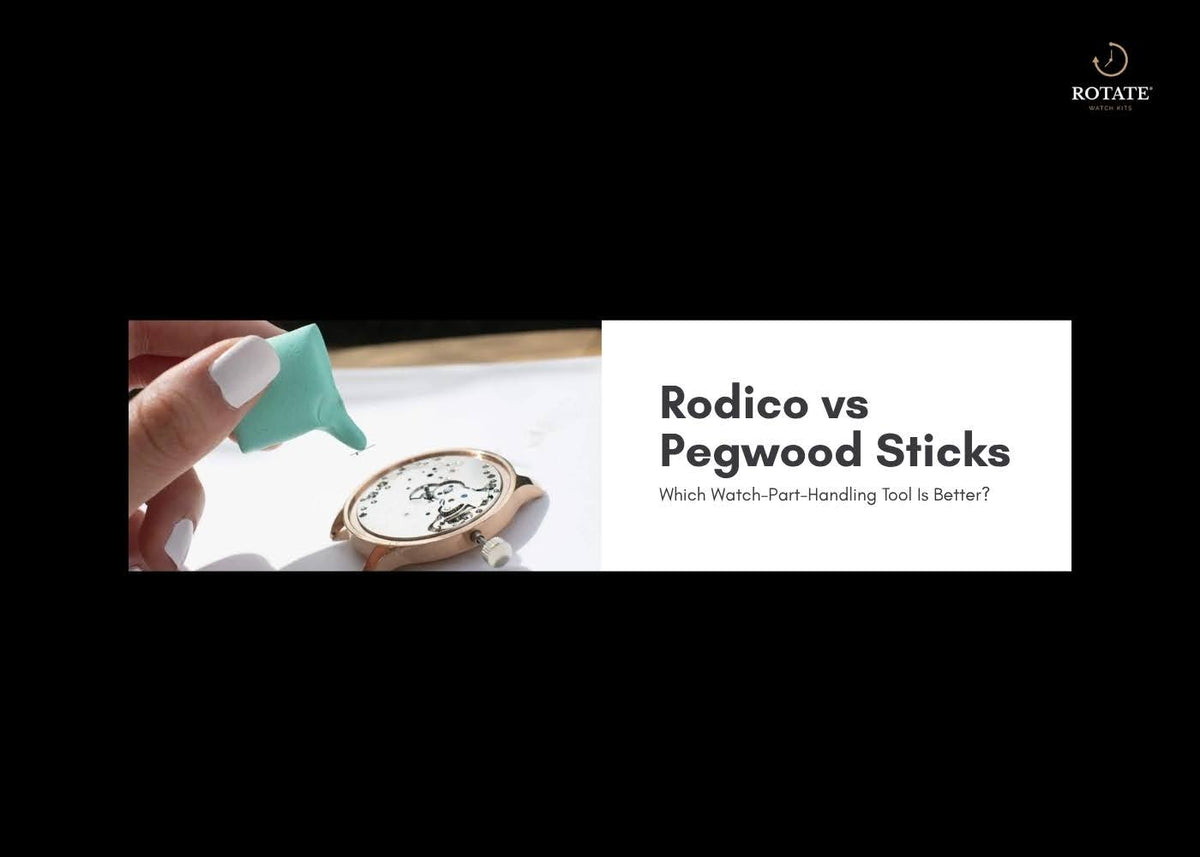
Rodico (Bergeon 6033, made by a Swiss tool manufacturer) is a soft, pliable watchmaker's putty designed specifically for cleaning and handling watch parts. The material picks up oils, dust, and fingerprints from metal surfaces on contact. For best results, use a light dabbing motion rather than wiping, since wiping increases residue risk.
Rodico works for:
- Removing fingerprints from movement plates and bridges
- Picking up tiny parts like cap jewels, screws, and springs
- Holding small components temporarily during assembly
- Cleaning exposed wheel teeth and lifting debris from tight areas
Because Rodico is reusable, a single stick lasts for years for hobby builders. The key rule is to always wear finger cots or gloves when handling it. Skin oils transfer into the putty and reduce its cleaning effectiveness over time. At $13, a stick of watchmaking putty is one of the most cost-effective tools in any watchmaker's kit.
Pegwood Stick Limitations
Pegwood is made from dried orange wood and shaped into a pointed dowel. The wood is hard enough to remove debris from jewel pivot holes but soft enough to avoid scratching metal surfaces. That balance makes pivot-hole cleaning its primary use case.
Pegwood is used for:
- Cleaning jewel pivot holes by rotating the sharpened tip inside
- Clearing debris from tight spaces that putty cannot reach
Outside of pivot hole work, though, pegwood is limited. The tips wear down quickly and require frequent reshaping with a pen knife. That resharpening process generates wood particles that can contaminate your workspace if you are not careful. Pegwood also costs $5 to $15 per pack, and because the sticks are consumable, you will need to replace them regularly. Rodico lasts far longer from a single purchase.
Why Rodico Wins for DIY Builders
For anyone working with a complete watchmaking kit, Rodico is the clear winner. Most assembly tasks involve holding, placing, and cleaning parts, and Rodico handles all three. Pegwood only becomes relevant once you reach the advanced movement-servicing level.
Rodico Covers Kit Assembly
During a standard watch kit build, you need to pick up small screws, clean fingerprints off bridges, and hold tiny springs in position. Rodico handles every one of those tasks without requiring resharpening, without generating wood dust, and without burning through consumable sticks the way pegwood does.
Pegwood Fills a Narrow Gap
Pegwood becomes necessary only at the movement level, specifically when you are disassembling and rebuilding the internal gear train. Cleaning jewel pivot holes requires the pointed tip and slight abrasion that pegwood provides. Some experienced watchmakers combine the two by placing a small piece of Rodico on a pegwood tip for precision part placement. That technique belongs to advanced servicing rather than basic kit assembly.
Important Warnings
Both tools can cause problems if used incorrectly, but pegwood carries more day-to-day risk for beginners.
Rodico Residue Risk
Some watch service centers restrict Rodico use on high-end movements because it can leave microscopic residue on sensitive surfaces. The risk increases when:
- Using soiled (already dirty) Rodico on clean parts
- Using Rodico on dials or hands, where it can leave marks on plated surfaces
- Handling Rodico with bare fingers instead of gloves
For DIY watch builds, the residual risk is minimal as long as you use fresh putty and wear the included gloves during assembly. One important note: never substitute Blu Tack or Silly Putty for Rodico, because household putties contain oils that can damage delicate watch components.
Pegwood Contamination Risk
Pegwood generates wood particles every time you resharpen it. Those particles can fall into the movement components if you reshape pegwood too close to your work area. For beginners who are still developing clean workspace habits, pegwood often creates more problems than it solves during early builds.
Build your own timepiece from scratch - shop DIY watch kits at Rotate Watches today.
Conclusion
When it comes to the Rodico vs. Pegwood decision, Rodico is the stronger choice for DIY watch builders. The putty handles cleaning, lifting, holding, and positioning, which covers roughly 90% of what you need at the bench. Pegwood fills a narrow niche in advanced movement servicing that most kit builders will not need during their first several projects.
Rotate Watches includes rodico putty with every kit, so you have the right part-handling tool from your very first build. Quality components and detailed guides keep the assembly process smooth, whether you are a first-time builder or an experienced hobbyist.
Start with a movement kit or a complete watchmaking kit to begin your watchmaking journey.
Frequently Asked Questions
Q1. Is Rodico or Pegwood better for beginners?
Rodico is the better choice for beginners because the putty handles cleaning, holding, and placing parts all in a single tool. Pegwood only cleans pivot holes, which is a task most beginners will not encounter until they move into advanced movement work.
Q2. Can I use Rodico on watch dials and hands?
You can, but use caution. Rodico may leave residue marks on plated dials and hands, especially if the putty is already soiled. Using fresh putty with gloves minimizes the risk, but many professionals avoid using Rodico on dials entirely.
Q3. How long does a stick of Rodico last?
For hobby builders, a single stick can last several years with proper care. Professional watchmakers who use it daily may go through one every few months. Pegwood sticks, on the other hand, wear out after just a few uses and need constant replacement.
Q4. What is pegwood made from?
Pegwood is made from dried orange wood, which gives it the right balance of hardness and softness. The material is firm enough to clean debris from pivot holes but gentle enough not to scratch metal surfaces or jewels.
Q5. Can I use Blu Tack instead of Rodico?
No. Blu Tack and Silly Putty contain oils that leave harmful residue on watch components and can damage sensitive surfaces over time. Only use putty specifically formulated for watchmaking, like Bergeon Rodico, to protect delicate parts.
Q6. Do I need both tools for a DIY watch kit build?
Rodico covers every part-handling task in a standard kit built on its own. Pegwood adds value only when you progress to movement kits, where pivot hole cleaning becomes necessary. Starting with Rodico alone is the right call for most builders.