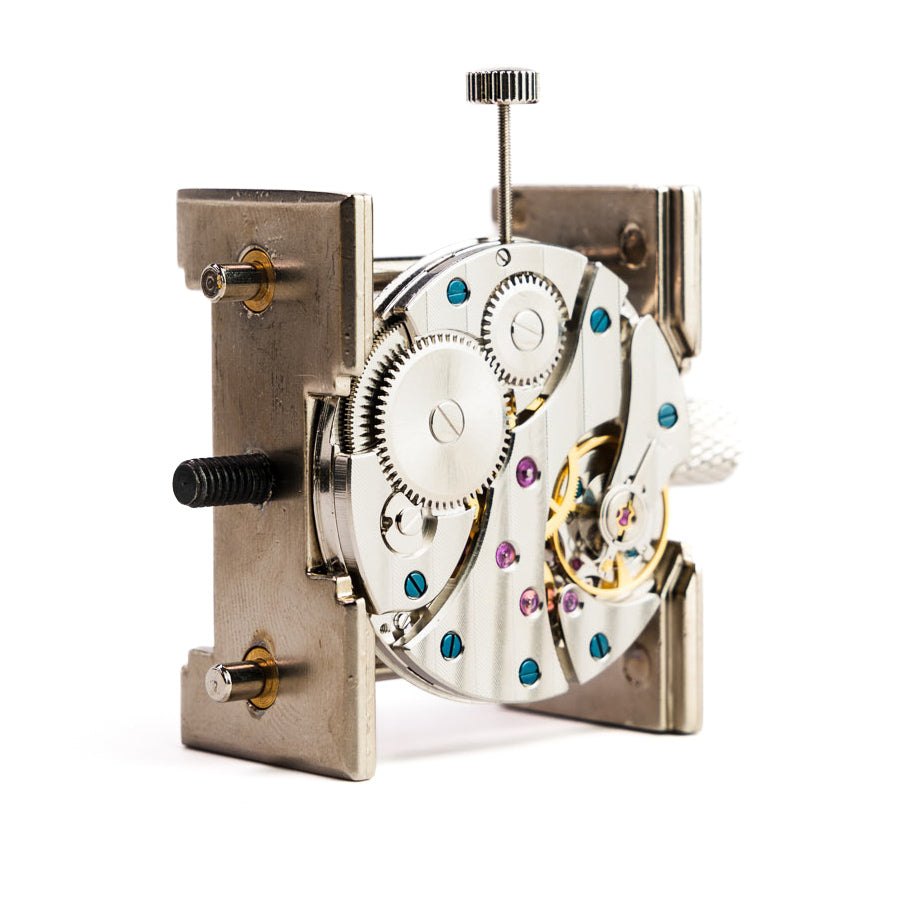


Watchmaking Tools Beyond the Starter Kit
You finished your first build. The tweezers, screwdriver, and spring bar tool that came in your kit did the job. As you tackle more complex projects, a few specialized tools help you work with finer tolerances and more delicate operations.
Moving past beginner builds means investing in professional watchmaking tools that handle finer tolerances and more delicate operations. The advanced watchmaking tools list below covers what you actually need at the intermediate level without wasting money on things that can wait.
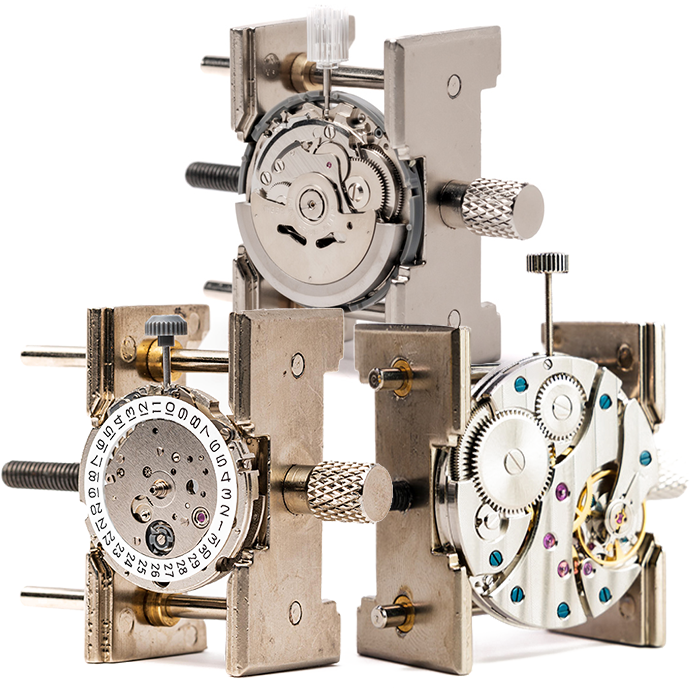
Progressing from a hand-wound movement kit to an automatic one changes what your tools need to handle. Whether you are starting to service watches or building more complex projects, these tools for watch servicing make the work easier and safer.
Precision Screwdrivers, Tweezers, and Holders
Your kit screwdrivers and tweezers cover standard builds well. Real watchmaking demands a full range of both. Screws inside movements vary widely, and using the wrong screwdriver size risks stripping heads or slipping onto delicate components.
A Full Set of Watchmaker's Screwdrivers
Watchmaker tools at an intermediate level start with screwdrivers in sizes from 0.5mm to 2.0mm. Look for sets with replaceable blades and swivel heads for controlled pressure. Sizes include:
- 0.6mm for tiny bridge screws
- 0.8mm for plate screws
- 1.0mm for case screws and general work
- 1.2mm to 1.6mm for larger movement screws
Magnification and Lighting
Seeing components at the right scale is half the battle. Sustained work requires hands-free magnification. Your starter kit loupe handles quick checks, but extended sessions demand better optics and dedicated lighting.
Good magnification paired with proper lighting reveals problems invisible to the naked eye. Dust, worn pivots, and misaligned components become obvious under the right setup.
Headband Magnifier or Stereo Microscope
A loupe magnifier at 5x zoom is excellent for quick inspections. For extended work, a headband magnifier with interchangeable lenses (1.5x to 3.5x) frees both hands. Serious hobbyists eventually invest in a stereo microscope (10x to 20x) that reveals hairline cracks and dust invisible to the naked eye.
Adjustable LED Desk Lamp
Overhead lighting creates shadows inside a movement. A gooseneck LED lamp with adjustable brightness eliminates shadows and reduces eye strain. Position the light at a low angle to spot surface debris.
Cleaning, Lubrication, and Handling
Keeping parts clean prevents contamination that causes timing problems after reassembly. Once you progress to servicing movements, proper lubrication becomes equally important. Dry pivots increase friction and accelerate wear.
Simple cleaning and lubrication tools cost very little but make a real difference in build quality. Organized storage prevents lost parts during long assembly sessions.
Peg Wood, Rodico Putty, and Rubber Blower
Peg wood cleans pivot and jewel holes without scratching. Sharpen the tip, insert it into a hole, and rotate. rodico putty picks up tiny screws, lifts dust from dials, and holds parts during placement without leaving residue.. A rubber dust blower removes particles from surfaces without physical contact. Squeeze the bulb to direct clean air into tight spaces between bridges and plates.
Oiler Set for Movement Servicing
An oiler with interchangeable fine tips applies precise amounts of oil to pivot points and jewels. Proper lubrication reduces friction at bearing surfaces and extends the life of the movement. Over-oiling causes as many problems as dry pivots, so controlled application matters.
Parts Trays and Dust Covers
Numbered compartment trays paired with dust covers keep disassembled parts clean and organized for hours between disassembly and reassembly. Label each compartment as you disassemble. Reassembly becomes much faster when every screw and spring has a marked location.
Case Work Tools
Opening and closing watch cases without damage requires tools beyond a basic case knife. Improper technique warps casebacks, breaks crystal gaskets, and compromises water resistance.
A quality case press handles the most common case sizes. Crystal and gasket tools round out the case work, which could be helpful for intermediate builders.
Case Press With Multiple Dies
A case press and opener set with interchangeable dies handles different case sizes. Pressing a caseback evenly with consistent force maintains the waterproofing seal. Hand-pressing risks uneven closure.
Crystal and Gasket Tools
Removing crystals demands a dedicated crystal press or lift tool. Gasket installation tools help seat rubber O-rings without stretching or tearing them. Damaged gaskets compromise water resistance even on watches rated for 5 ATM or higher.
Hand Removal and Installation
Pressing the watch hands on and off is nerve-wracking. Dedicated tools make it reliable. Hands sit on friction-fit posts measured in fractions of a millimeter. Slight misalignment bends posts or scratches dials.
Proper hand tools pay for themselves after one or two builds. The confidence they provide makes complex dial work far less stressful.
Hand Pullers and Pushers
A presto-style hand puller grips the hand and lifts straight off without bending. Hand pushers press hands onto posts with controlled, even force. Different tip sizes match different hand tube diameters.
Timing and Regulation
Checking accuracy becomes part of the workflow once you start servicing movements. Regulation separates functional watches from well-tuned timepieces.
A timegrapher gives you objective data instead of guesswork. Measuring performance before and after adjustments shows what your regulation achieved.
A Timegrapher
A timegrapher measures rate, amplitude, and beat error by listening to ticks. Phone apps range from free to about $10, while dedicated devices range from $150 to $500. Key metrics include:
- Rate (seconds gained or lost per day)
- Amplitude (swing angle of the balance wheel)
- Beat error (symmetry of the tick-tock rhythm)
Make your own watch and discover the engineering behind every tick.
Conclusion
Your kit tools give you a solid foundation for building watches. Quality screwdrivers, proper magnification, cleaning supplies, and a case press transform watchmaking from a one-time project into a lasting skill.
Rotate Watches offers DIY watch-building kits, movement kits, and individual accessories to help you level up. Each kit includes helpful starter tools, and the accessories above take your builds to the next level.
FAQs
Q1. How much do watchmaker's screwdrivers cost?
Quality sets start around $30 to $60 for hobbyist-grade and $100+ for professional brands like Bergeon or Horotec. Budget sets work for occasional use, but replaceable-blade sets last much longer. Look for swivel heads and color-coded sizes for quick identification during movement work.
Q2. Do I need a microscope for watchmaking?
Not at the beginner level, but a stereo microscope helps once you start cleaning and regulating movements. A 10x to 20x stereo microscope reveals wear patterns invisible through a loupe. Many watchmakers use 10x for hands-on work and switch to 20x for detailed inspection of pivots and jewels.
Q3. What is a timegrapher used for?
A timegrapher measures accuracy, amplitude, and beat error to verify performance before and after servicing. Phone apps provide a budget-friendly starting point for hobbyists, while dedicated devices like the Weishi 1000 offer more reliable readings. Checking all three metrics together gives a complete picture of movement health.
Q4. Is Rodico putty reusable?
Yes. A single block lasts through several projects. Replace it when the putty stops picking up particles cleanly or starts leaving residue on components. Store it in a sealed container between uses to keep it free from dust and debris.
Q5. What is the most important tool upgrade for intermediate watchmakers?
A quality set of precision screwdrivers with multiple sizes is the single most impactful upgrade. Proper screwdrivers prevent stripped screws and protect delicate movement components. A set covering 0.5mm to 2.0mm with replaceable blades handles nearly every screw you will encounter in standard movements.