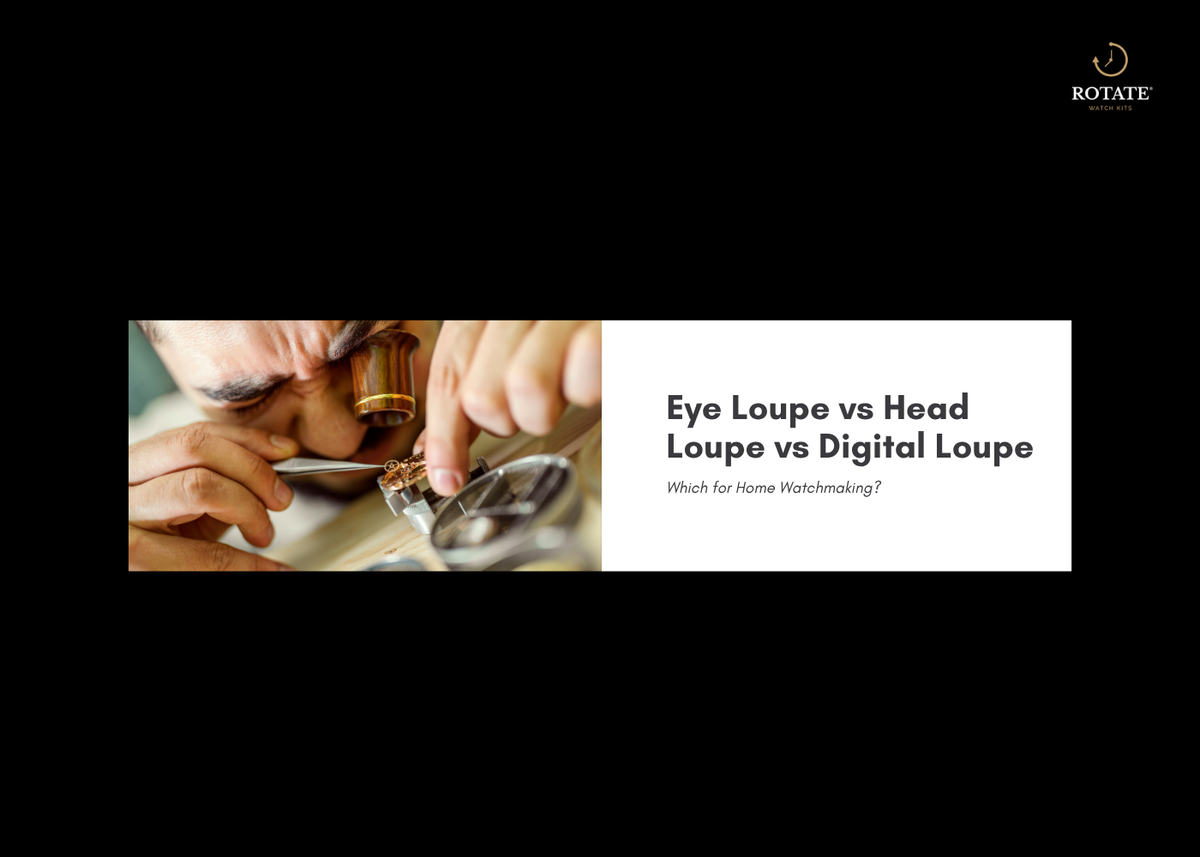
Eye Loupe vs Head Loupe vs Digital Loupe: Which for Home Watchmaking?
You are sitting at your workbench with a hand-wound movement kit disassembled in front of you. The pallet fork jewels look like specks of red dust. The hairspring coil is thinner than a strand of hair.
A good loupe adds precision and confidence to your assembly work. Home watchmakers choose from three main types: eye loupes, head loupes, and digital loupes, each suited to different needs, budgets, and working styles.
Key Takeaways
- Eye loupes offer the highest optical clarity and are the industry standard for professional watchmakers.
- Head loupes provide hands-free magnification with reduced facial fatigue for longer sessions.
- Digital loupes display magnified images on a screen, ideal for sharing and documentation.
- Beginners should start with a 3x to 5x eye loupe before investing in specialized tools.
- The best loupe for beginners in watchmaking depends on session length, budget, and eyesight. An eye loupe is a good starting point for most builders.
Quick Comparison
| Feature | Eye Loupe | Head Loupe | Digital Loupe |
|---|---|---|---|
| Magnification Range | 2.5x to 20x | 1.5x to 3.5x | Up to 200x+ |
| Price Range | $10 to $100+ | $15 to $80 | $30 to $500+ |
| Best For | Assembly, inspection, escapement work | Long sessions, general assembly | Documentation, screen sharing |
| Portability | Pocket-sized | Bulky | Requires power source |
| Power Needed | None | None | Battery or USB |
| Depth Perception | Monocular (one eye) | Binocular (both eyes) | 2D screen only |
Eye Loupes: The Classic Choice
The traditional watchmaker's loupe is a small magnifying lens held in the eye socket. Professional watchmakers worldwide have relied on this simple tool for generations, and it remains the standard for precision work today.
How Eye Loupes Work
An eye loupe consists of a single or compound lens mounted in a metal or plastic housing. You squint slightly to hold the loupe against your eye socket, which keeps both hands free for work. Quality loupes use precision-ground glass rather than plastic, producing sharper images with less distortion.
Magnification Options
Eye loupes come in a range of magnifications. Watchmakers typically use:
- 2.5x to 4x for general inspection, case work, and dial evaluation
- 5x for component handling and assembly (a solid starting point for DIY builders)
- 10x for detailed work on escapements, jewels, and hairsprings
- 15x to 20x for specialized inspection (very narrow field of view)
Higher magnification reduces the field of view and depth of field. A 10x loupe shows incredible detail but requires steady hands and close working distance. Most beginners find 5x magnification practical for watch kit assembly.
Lens construction also affects clarity. Singlet loupes use one lens and work well at lower magnifications, where edge distortion stays minimal. Triplet loupes bond three glass elements together, correcting color fringing and delivering sharp focus across the entire field of view. Triplet construction matters most at 10x and above, where optical precision becomes critical.
Working distance shrinks as magnification increases. A 4x loupe provides roughly three to four inches between your eye and the work, leaving room for tools. A 10x loupe cuts that gap to about one inch. The 5x range balances detail with enough clearance to handle tweezers and screwdrivers comfortably.
Pros and Cons
Advantages:
- Best optical clarity per dollar
- Compact and portable
- No batteries or charging needed
- Direct eye-to-work connection
Disadvantages:
- Can cause eye and facial fatigue during long sessions
- Takes practice to hold in the eye socket
- Only magnifies for one eye at a time
- Higher magnifications require very steady positioning
A 5x loupe magnifier at $10 covers the magnification range most home watchmakers need, and represents strong value for kit assembly and general movement work. For home builders, a well-made 5x loupe is the only magnification tool needed from first build to advanced projects. However, those higher-end options are geared toward full-time bench professionals working eight-hour shifts.
Head Loupes: Comfort for Longer Sessions
Head loupes, also called headband magnifiers, strap onto the head like a visor and position lenses in front of both eyes.
How Head Loupes Work
A headband or frame sits around the forehead and supports one or more interchangeable lenses that flip down in front of the eyes, because both eyes look through the optics, the binocular design preserves depth perception, unlike single-eye loupes. The weight also distributes across the head rather than pressing against the eye socket, which reduces fatigue during longer sessions.
Magnification and Lens Options
Most head loupes ship with multiple interchangeable lenses, typically covering 1.5x to 3.5x magnification. Some models allow stacking lenses for higher magnification, though image quality degrades with each added layer. Since head loupes sit farther from the eye than traditional loupes, working distance increases, allowing a more upright posture at the bench.
Pros and Cons
Advantages:
- Both hands remain completely free
- Reduced eye socket pressure and facial fatigue
- Binocular vision preserves depth perception
- Comfortable for sessions lasting one hour or more
- Accommodates eyeglass wearers
Disadvantages:
- Lower maximum magnification than eye loupes
- Alignment can shift during movement
- Less precise focus compared to single-lens eye loupes
- Bulky, not portable
Head loupes range from $15 to $80 for quality options, though budget models may use plastic lenses with more distortion. For home DIY watchmaking, a head loupe works well as a secondary tool for longer assembly sessions where comfort matters more than maximum magnification.
Digital Loupes: The Modern Option
Digital loupes replace traditional optics with a camera and screen, displaying magnified images on a monitor rather than through a lens you hold against your eye. A digital loupe for watch repair offers the newest approach to magnification.
How Digital Loupes Work
A small camera with a built-in lens captures the work area and displays the magnified image on an attached screen, tablet, or monitor. Some models mount on the head like traditional loupes, while others use a stand or flexible arm to position the camera over the workbench.
Magnification and Features
Digital loupes offer extreme magnification ranges, sometimes up to 200x or more, though resolution depends on camera quality. Many models also include built-in LED lighting, image capture, and video recording. The screen display eliminates eye strain entirely, since you look at a monitor instead of squinting through a lens.
Pros and Cons
Advantages:
- Zero eye strain (viewing a screen, not a lens)
- Built-in lighting for consistent illumination
- Image and video recording for documentation
- Screen sharing allows others to observe your work
- Extreme magnification available
Disadvantages:
- Slight display lag can affect precision hand movements
- Depth perception is limited (2D screen)
- Requires power source (battery or USB)
- Higher cost for quality optics and display
- Learning curve for working via screen rather than direct viewing
Digital loupes start around $30 for basic USB models and range to $500+ for professional systems with high-resolution cameras and adjustable stands. At the professional end, IWC's Cyberloupe integrates augmented reality and live streaming into a digital watchmaking loupe. However, it remains a professional-grade tool well outside the home workshop budget for most builders.
Choosing the Right Loupe for Your Level
The right loupe depends on what you are building and how deep into watchmaking you plan to go. Here is how each type maps to common experience levels.
For First-Time Kit Builders
A 5x eye loupe handles everything needed to assemble a DIY watch kit. Assembly work involves installing hands, setting dials, and handling crowns, all of which are visible at moderate magnification. Hand-wound starter kits begin at $195 and pair perfectly with a 5x loupe for a first build.
For Movement Kit Enthusiasts
Builders working with movement kits that involve full disassembly benefit from a 5x eye loupe for general work and a 10x loupe for inspecting escapements, jewels, and hairsprings. An eye loupe remains a useful companion at every skill level. A head loupe adds comfort during longer builds, especially the three to five hours a multi-movement bundle typically requires.
For Documentation and Sharing
Digital loupes excel when you want to photograph or video your build process. Connecting one to a screen lets others watch your work in real time, perfect for sharing your hobby or teaching others.
Conclusion
An eye loupe is a versatile magnification tool for home watchmaking. Head loupes and digital loupes serve useful secondary roles, but an eye loupe handles the widest range of tasks at the lowest cost. Professional watchmakers worldwide build entire careers around a quality eye loupe, and home builders benefit from the same direct optical connection to their work.
Rotate Watches offers a 5x loupe magnifier, watchmaking kits, and movement kits. Pair the right magnification with the right build, and every component comes into focus.
FAQs
What magnification loupe do I need for watchmaking?
A 5x loupe covers general assembly, while a 10x loupe suits detailed escapement work. Avoid going above 10x until you have experience, as higher magnification reduces the field of view dramatically.
Can I use a head loupe for watch assembly?
Yes, head loupes work well for longer assembly sessions. The binocular design provides depth perception and comfort, though maximum magnification is lower than that of dedicated eye loupes.
Are digital loupes better than traditional loupes?
Not necessarily. Digital loupes eliminate eye strain and allow recording. However, slight display lag and the lack of depth perception make precision hand work more challenging.
Do I need a loupe for DIY watch kit assembly?
A loupe is a helpful addition, especially for hand installation and small component handling. A 5x magnifier handles the job well for most kit builds.
How much should I spend on a watchmaking loupe?
A quality eye loupe starts at $10, and head loupes range from $15 to $80. Spend more only when you move to advanced movement work requiring 10x or higher magnification.
Can I wear glasses with a watchmaking loupe?
Head loupes and some eye loupe models accommodate glasses. Traditional eye socket loupes may require removing glasses, though some models are designed to sit over frames.